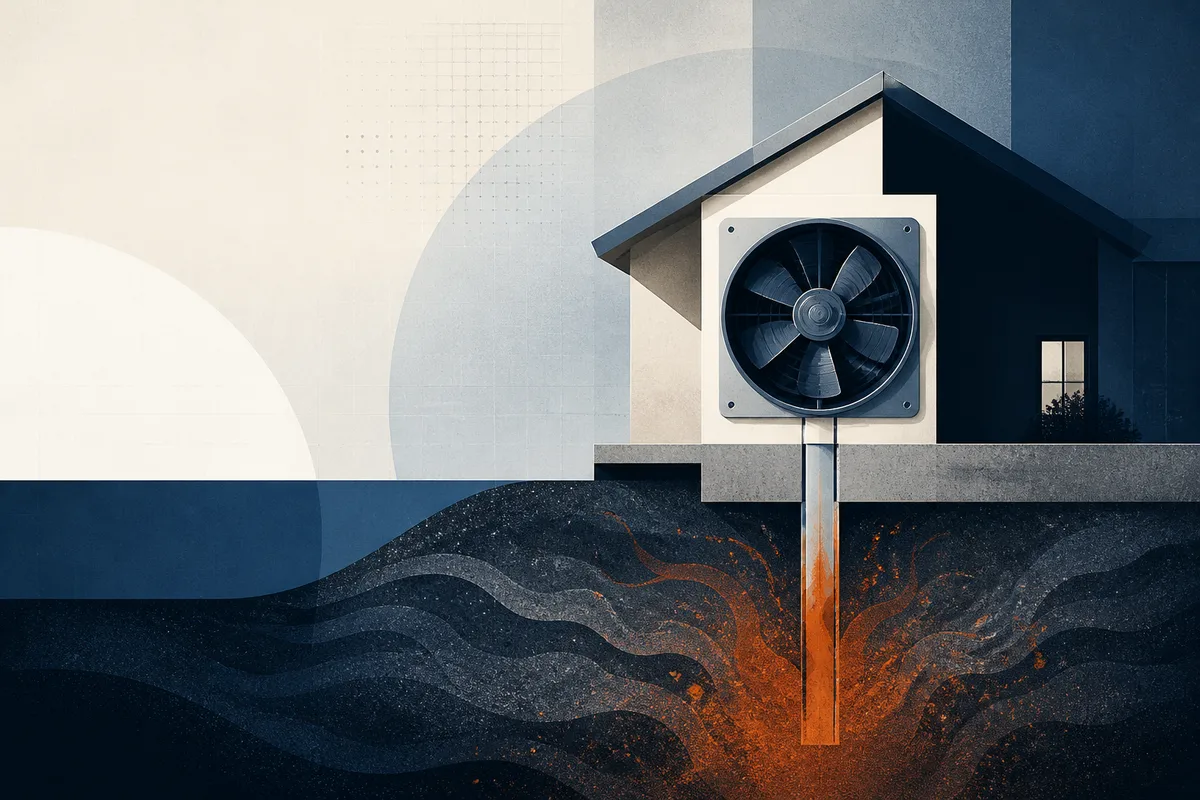
Why a Bigger Fan Often Fails to Fix Radon Levels
A common mistake in radon mitigation is assuming that a more powerful fan will yield lower radon levels. In reality, an oversized fan often creates high-velocity noise and internal heat buildup that shortens the equipment’s lifespan. Effective mitigation relies on creating a slight vacuum under the entire house, a process that depends entirely on how easily air moves through the soil or aggregate beneath the concrete.
This radon fan sizing guide explains how to balance static pressure and airflow to ensure long-term system performance. For homeowners and property managers, understanding these mechanics is the difference between a quiet, efficient system and one that requires constant repair.
Why Oversized Radon Fans Fail
Installing a fan with excessive vacuum capacity without considering soil density causes several mechanical and structural issues. When a fan tries to pull more air than the sub-slab environment can provide, it creates a high-friction environment that degrades components.
- Internal motor temperatures rise when the fan is starved for air, leading to bearing failure.
- High-suction fans pull conditioned air from inside the home through slab cracks, increasing heating and cooling costs.
- Rapid airflow through small-diameter pipes creates a persistent whistling or rushing sound that resonates through the home’s framing.
- Excessive vibration can loosen pipe hangers and create rhythmic humming in bedrooms located near the vent stack.
The Framework for Professional Fan Selection
Selecting the right equipment requires moving beyond guesswork and using diagnostic data to map the sub-slab environment. According to radonpds.com, manufacturers can accurately predict performance when fans are placed on specified duct sizes.
1Perform a Sub-Slab Communication Test
Before selecting a fan, a technician drills a small suction pit and several distant "pilot holes" around the slab perimeter. By applying a vacuum to the suction pit and measuring the pressure drop at the pilot holes with a micromanometer, the contractor determines the soil porosity. This is often called a Pressure Field Extension (PFE) test, and it identifies whether the sub-slab material is tight clay or loose gravel.
2Calculate Radon System Static Pressure
Static pressure is the resistance the fan must overcome to move air. A system built on heavy clay requires a high-suction radon fan capable of overcoming high resistance, even if the total volume of air moved is low. Conversely, a house built on clean gravel needs a high-flow fan that can move large volumes of air at low pressure. American Radon Mitigation notes that bigger isn't always better when choosing these components.
3Verify Pipe Diameter Compatibility
The physical size of the vent pipe limits the fan's effectiveness. The actual pipe diameter—typically 3 or 4 inches—must be matched to the fan's exhaust port to prevent backpressure. RadonPDS indicates that fans are typically placed on specified duct sizes ranging from 4 to 10 inches or more depending on the application.
4Optimize the Suction Pit
The efficiency of any fan is capped by the quality of the suction pit. A professional installer excavates a void under the slab to increase the surface area for the vacuum. This allows a smaller, quieter fan to achieve the same pressure field extension as a larger fan struggling against a small hole.
The Role of Soil Porosity in System Design
Soil porosity is a primary variable in mitigation design. According to the EPA Consumer's Guide to Radon Reduction, radon enters a home because the air pressure inside is usually lower than the pressure in the soil around the foundation.
To reverse this, the mitigation system must be tuned to the specific "leakiness" of the soil. If the aggregate is highly porous, a low-wattage fan can easily protect a large footprint. If the soil is dense, the system requires a fan engineered specifically for high static pressure. Using the wrong tool for the soil type results in a system that is either ineffective at moving radon or needlessly expensive to operate. Suncourt notes that sub-slab suction is directly affected by these sizing choices.
The metric unit used to measure the strength of the vacuum under the slab; a successful system maintains a measurable pressure differential at the furthest point from the fan to ensure the entire footprint is under negative pressure.
Professional Evaluation and Repair
When a system underperforms or makes excessive noise, a diagnostic evaluation is necessary to determine if the equipment is mismatched to the foundation. This process involves checking the U-tube manometer for pressure changes and inspecting the exterior vent for signs of moisture or debris. If the current equipment is failing, a qualified contractor can utilize a PFE test to evaluate if the foundation requires a different equipment configuration or an additional suction point to achieve pressure field extension. For homes with aging systems, a professional radon system repair evaluation can help determine if the fan is operating within its intended design parameters or struggling against excessive resistance.
More detail on the work itself: Minneapolis Radon Services.
Frequently asked questions
How do I know if my radon fan is the wrong size?
If your U-tube manometer shows an extremely high reading but your radon levels remain high, the fan may be unable to move enough air through tight soil. Conversely, if the fan is extremely loud and vibrates the walls, it may be moving more air than the piping can handle.
Can I just swap a failing fan for a more powerful one?
No, swapping for a more powerful motor without addressing sub-slab resistance often leads to the same failure. The EPA recommends that you have a qualified radon mitigation contractor select the appropriate reduction method based on diagnostic testing.
Why is my radon fan making a loud whistling noise?
Whistling usually indicates high-velocity airflow through a restriction, such as a small pipe connected to a fan designed for larger ducting. It can also be caused by air being pulled through small, unsealed cracks in the basement floor, which should be addressed with professional slab sealing.
Does a larger fan use significantly more electricity?
High-suction fans can draw more power than standard models. Over the course of a year, an improperly sized fan can add to a utility bill, making it more cost-effective to install a correctly sized system from the start.
How long should a radon fan last?
While lifespans vary, a fan that is correctly matched to the sub-slab pressure will operate more efficiently. Fans that are "starved" for air due to tight soil or restricted piping will often fail prematurely due to heat buildup in the motor housing.
What should I do if my radon levels are still high after installing a system?
First, verify the system is running by checking the liquid levels in the manometer. If the system is active and radon levels are 4 pCi/L or higher, a contractor should perform radon testing and diagnostic checks to confirm pressure field extension in the areas furthest from the suction point.
What happens when you get in touch: you describe the situation, we ask the few questions that actually change the answer, and you get a clear scope and next step — no obligation.