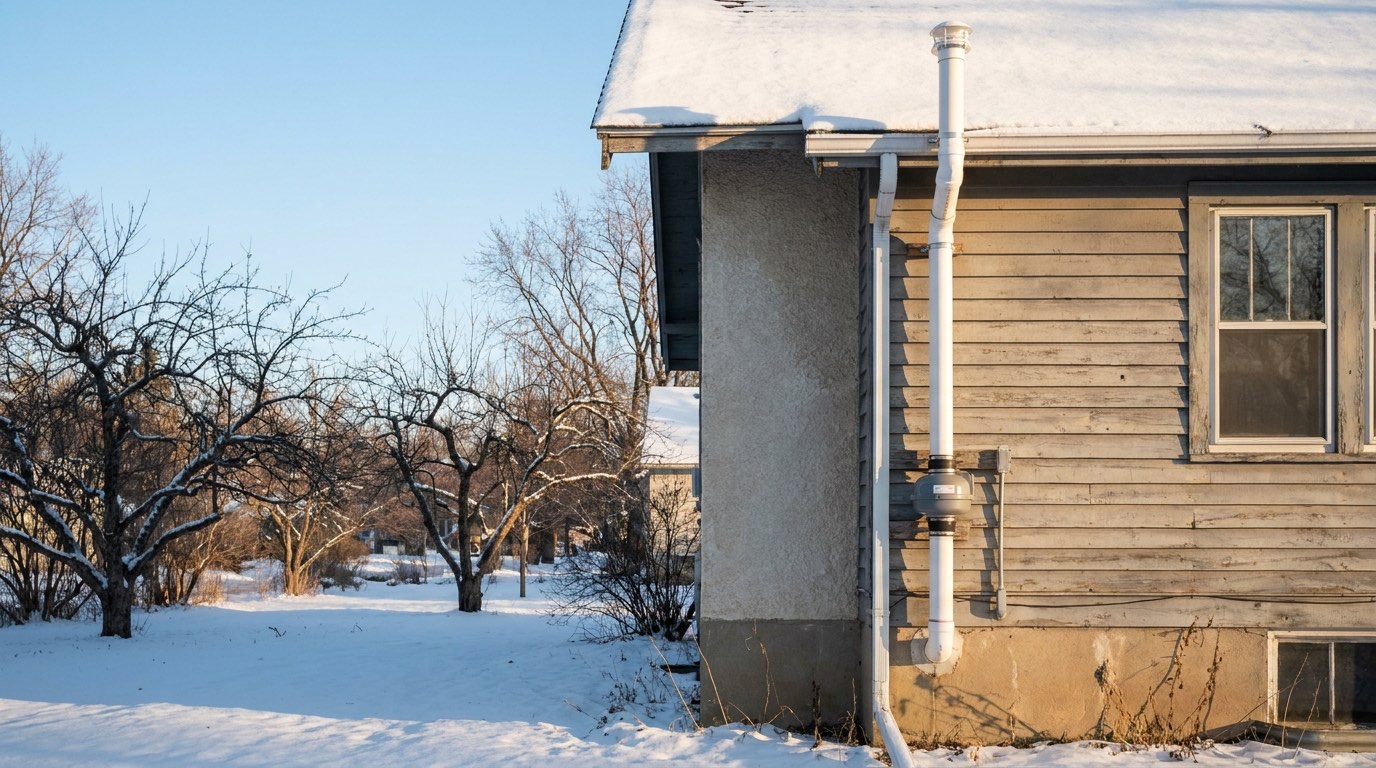
White radon mitigation pipe with an inline fan running up the side of an older stucco and clapboard house to above the roof edge, snow on the roof and yard on a clear winter morning
Free on-site estimates across the Twin Cities

Radon Testing & Mitigation in Minneapolis–St. Paul

The Minnesota Department of Health puts more than two in five Minnesota homes at a radon level that is a significant health risk. A two-day test tells you if yours is one — and if it is, a system brings it down and a retest proves it.

Free estimates. The retest is included.

Call Now (952) 206-5195
Minneapolis Radon Services

Request a Free Estimate

Working to an inspection deadline? Call (952) 206-5195 — inspection contingencies do not wait.

Got it — thank you.

We will call you shortly to book the estimate. Need us sooner? (952) 206-5195

What the number means

Every Radon Decision Comes Down to One Line

Radon is measured in picocuries per litre — pCi/L. The whole trade, and every argument in a home sale, turns on which side of 4.0 your reading lands. Here is the scale your result gets read against.

4.0 — EPA action levelpCi/L
Under 2.0Low
Nothing to do. Retest in a couple of years, and after any work that changes the foundation or the heating.
2.0 – 4.0Consider a fix
Below the action level, and the EPA still suggests weighing it up. A summer reading in this band is worth repeating in winter.
4.0 and overFix it
At or above the EPA action level. This is what a mitigation system is for, and it is the reading that stops a sale.

No radon level is known to be harmless — the risk falls as the number falls, it does not switch off. Most systems aim to leave a house comfortably under 2.

Why Twin Cities Houses Read High

Glacial Ground, Long Winters, Lived-In Basements

Radon comes from uranium breaking down in soil and rock. In Minnesota three conditions stack up to pull it indoors, and you cannot sense any of them from inside the house.

The Glaciers Left Uranium Behind

Most of the metro sits on material the ice sheets carried in. The till the Des Moines lobe spread across southern and western Minnesota contains shale from the Dakotas and Manitoba, and shale tends to carry more uranium than most rock. As it decays it produces radon, which moves through the soil toward the lowest-pressure space nearby — your basement.

Six Months of Stack Effect

From October to April a heated house loses warm air through the top and replaces it from the bottom — through the sump basket, the floor drain, the crack along the wall. The colder it is outside, the harder the house pulls. Frozen, snow-covered ground can also cap the soil around the house and leave the basement as the easiest way out.

The Basement Is a Room

Twin Cities basements are family rooms, bedrooms, offices and rental suites. That is exactly where radon concentrates, and a finished basement is also a tighter one — less leakage to dilute what comes up through the floor.

A Passive Pipe Is Not a System

Since June 2009 Minnesota has required new homes to be built with a passive radon pipe. Without a fan it relies on natural draft, and whether that is enough is exactly what nobody measured. The only proof of any system — passive, active or inherited — is a test.

What We Do

Testing, Mitigation and Proof It Worked

Houses, townhomes, multi-family and commercial. Sub-slab systems, crawl space membranes, passive systems that need a fan, home-sale deadlines and repairs to systems someone else installed.

Radon Testing

A continuous monitor in the lowest lived-in level for at least 48 hours, logging every hour — a curve you can read, not one number that might be a fluke.

Learn More →

Radon Mitigation Systems

The standard fix for a Twin Cities basement or slab: suction under the floor, the gaps sealed, a fan outside the living space and a discharge above the roof — built for a Minnesota winter.

Learn More →

Crawl Space Radon Mitigation

A dirt crawl space under an addition, a porch conversion or an older house has no floor to stop soil gas. A sealed membrane with suction under it builds the missing one.

Learn More →

Real Estate Radon Testing

Placed and collected to fit your inspection window, with a report written for the file — and a straight answer on the date before you book.

Learn More →

Post-Mitigation Retesting

A second test once the system has been running. Included with every install, and available on its own for a system nobody has checked.

Learn More →

Sump Pit & Slab Sealing

An open sump basket or a dry floor drain is a direct line to the soil. Sealing them is what lets a system work — and where cheap installs cut corners.

Learn More →

Commercial & Multi-Family Radon

Bigger buildings change the protocol, not the physics — more placements, ventilation systems in the mix and more people who need the report.

Learn More →

Radon System Repair

Dead fans, iced discharges, passive pipes that never worked. We test first, then fix what the reading says is wrong.

Learn More →

Why Us

Why Minneapolis Homeowners Call Us First

The complaints in this trade are rarely about the drilling. They are about a system sold without a proper test first, or installed and never checked again.

A Test Comes Before a Quote
No one gets priced for a system they may not need. We measure first, and if the reading is low we say so and leave. A company that quotes before it measures is guessing.
The Retest Is Built In
Every system we install gets a post-mitigation test at no extra charge. You get the before and after readings together — the pair a future buyer will ask for under Minnesota's disclosure law.
Built for a Minnesota Winter
Fan location, pipe slope and routing are chosen so condensation drains back instead of freezing, and the discharge does not ice over in January. Cold-weather detail is where rushed installs fail.
Sealing Is Part of the Job
The sump basket, floor drain, wall joint and pipe penetrations get sealed as part of the install, not sold as extras. It is what makes the fan pull soil gas instead of air you paid to heat.
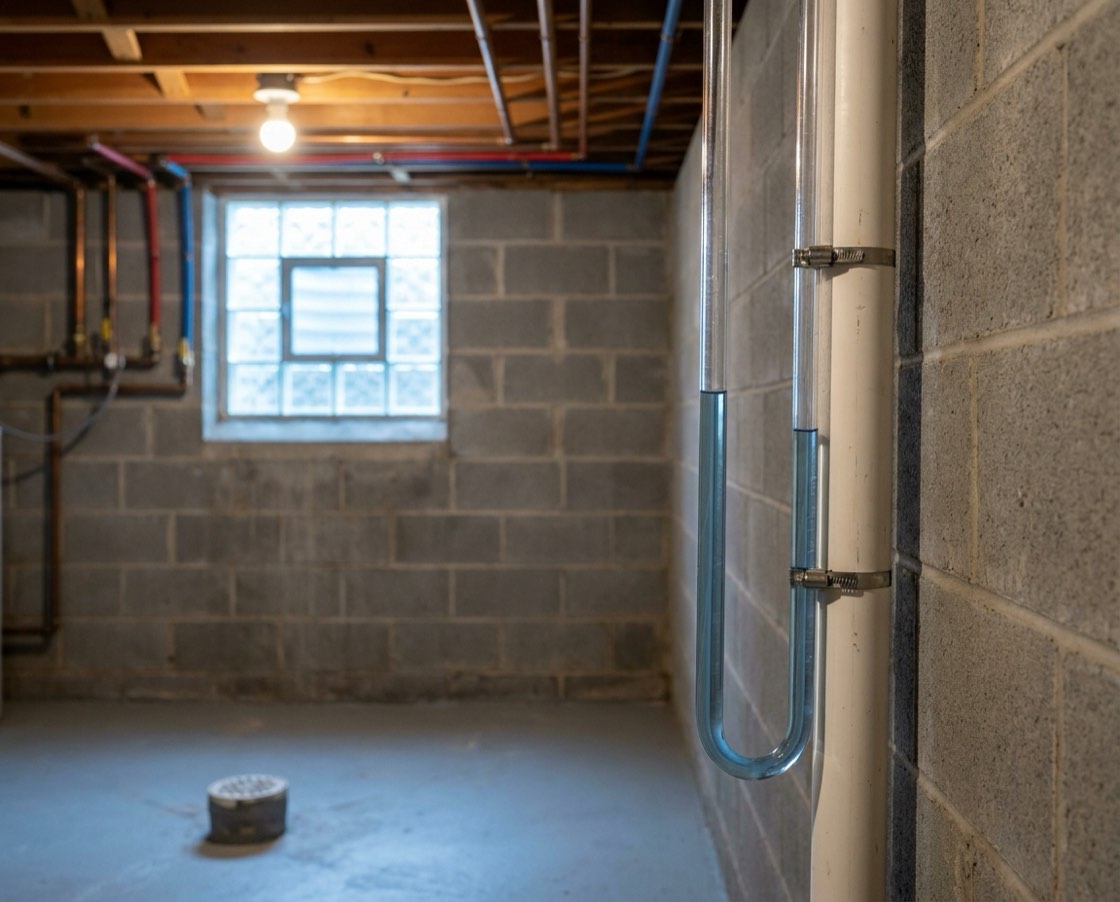
U-tube manometer strapped to a white radon pipe in an unfinished basement with concrete block walls and a glass-block window, the fluid sitting at two different heights to show the fan is pulling

How It Goes

Measure, Mitigate, Measure Again

Four steps, in the same order every time, and the estimate is free.

  1. Call or Request an Estimate

    Tell us about the house — basement, split-entry, walkout, crawl space or slab — and whether a sale or inspection date is involved. You get a likely picture on the phone and a visit booked.

  2. 48-Hour Test

    A continuous monitor in the lowest lived-in level under closed-house conditions, logging every hour. You get the full curve, not just the average.

  3. A System, If You Need One

    Suction under the slab, the sump and drains sealed, the pipe routed to stay warm, a fan outside the living space and a discharge above the roof. Most houses take a single day.

  4. Retest and Hand Over

    A second test once the system has settled. Both readings go on paper — the document a buyer, a lender or your own peace of mind is actually asking for.

Where We Work

Radon Mitigation Across the Twin Cities metro

Serving Hennepin, Ramsey, Dakota, Washington and Anoka counties with free on-site estimates.

Not on the list? Call anyway — if we are already working on that side of the river it is usually no problem.

Questions

Common Questions About Radon

How much does radon mitigation cost in the Twin Cities?
It depends on the foundation, not the reading. A single-slab basement with a clean pipe route is the simplest case. Crawl spaces, split-levels with two slabs, and routes through finished space cost more. A post-2009 house with a passive pipe already in place is usually the cheapest of all, because most of the pipe is there. We quote after looking, and you approve the number first.
What radon level is dangerous?
The EPA action level is 4.0 pCi/L, and it recommends considering a fix between 2.0 and 4.0. There is no level known to be harmless — risk falls as the number falls. Most systems aim to leave a house comfortably under 2.
Is radon really a problem in Minnesota?
The Minnesota Department of Health says more than two in five Minnesota homes have radon at a level that is a significant health risk, and that the state's average is more than three times the national one. That is about the state, not your house — only a test at your address settles it.
Does a new house need testing if it has a radon pipe?
Yes. Minnesota has required a passive radon system in new homes since June 2009, but passive means no fan — it relies on natural draft and nobody checked whether that is enough. A test answers it, and if it is not enough, adding a fan is usually a small job.
My neighbour tested low. Do I need to test?
Yes. Houses side by side read differently all the time, depending on the foundation, how much of it touches soil and how the house is sealed and heated. Radon is measured per house, never per street.
We are selling. Do we have to test?
No. Minnesota's Radon Awareness Act requires sellers to disclose what they know — past tests, results, any mitigation system and its paperwork — and give buyers the MDH booklet “Radon in Real Estate Transactions.” It does not require a test. Many buyers test during their inspection period anyway, so it is worth knowing where you stand.
Will a system make my house colder?
The fan pulls a little conditioned air through any gap that was not sealed, and in a Minnesota winter that is noticeable on the heating bill. That is why sealing the floor is part of the install. The fan itself sits outside the living space.
How often should I retest?
Every couple of years, and after anything that changes the house — foundation work, a new furnace or water heater, finishing the basement, new windows or an addition. Also any time the gauge on the pipe shows level columns, which means the fan has stopped.
No Smell, No Colour, No Warning

Radon gives you nothing to notice — not in a Minneapolis bungalow, not in a new build in Woodbury. The only way to know which side of the line your house sits on is to measure it for two days with the windows shut.

Call Now Free Estimate