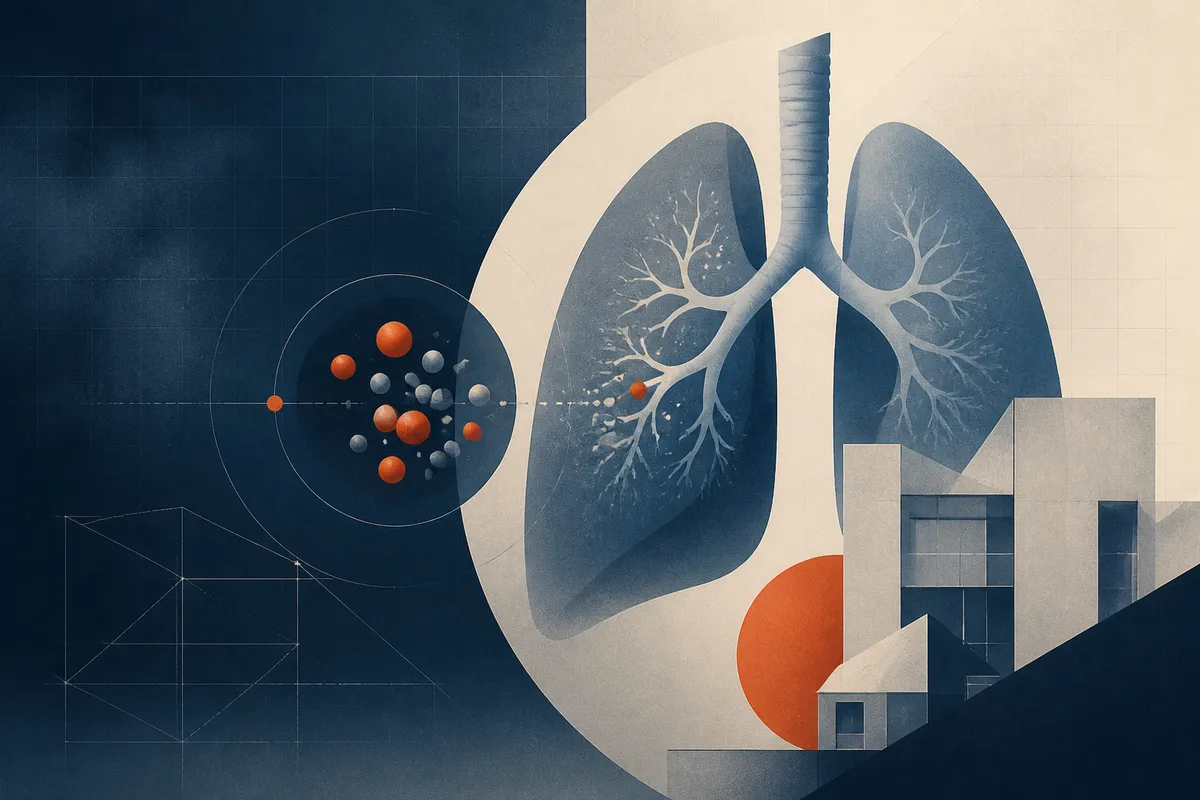
The Biological Mechanism of Radon-Induced Lung Cancer in Non-Smokers
Most property owners view radon as a binary "pass/fail" check during a real estate transaction, yet the biological reality is a matter of cumulative cellular degradation. In the Twin Cities, where the local geology contributes to elevated indoor concentrations, the risk is often invisible until a medical diagnosis occurs. For non-smokers, the absence of tobacco-related inflammation often leads to a false sense of security regarding respiratory health.
This article examines the transition of radon gas from an inert environmental element to a localized radioactive source within the human body. It outlines the specific pathway of alpha radiation damage and the operational steps required to quantify and reduce that risk in residential and commercial properties.
Why Ambient Radon Risks are Systematically Underestimated
The danger of radon remains underestimated because the lag time between exposure and cellular malignancy often spans decades. This delay creates a disconnect between the environmental cause and the clinical effect.
- Indoor air frequently traps radon at concentrations significantly higher than outdoor levels due to the "stack effect" in modern, airtight construction.
- Non-smokers often lack the routine respiratory screenings provided to long-term smokers, delaying the detection of radon-linked nodules.
- Common granite or concrete building materials are often blamed for radon, when the vast majority of gas enters through sub-slab soil gas migration.
- Short-term "charcoal canister" tests provide only a snapshot that may miss seasonal spikes caused by frozen soil or heavy precipitation.
The Pathological Framework of Radon Progeny Inhalation
Understanding the risk requires moving beyond the gas itself to the heavy-metal particles it leaves behind during its 3.8-day half-life.
1Inhalation of Radon Progeny
When radon gas decays, it produces solid radioactive isotopes including polonium-218 and polonium-214. These "progeny" are chemically active and easily attach to indoor dust, smoke, or aerosols. Once inhaled, these particles are not exhaled like the inert gas; they remain trapped in the mucus lining of the lungs.
2Alpha Particle Emission
The trapped progeny continue to decay, emitting alpha particles directly into the surrounding lung tissue. While alpha radiation cannot penetrate a sheet of paper or human skin, it is devastatingly effective when emitted internally. These particles are heavy and carry a high amount of energy over a very short distance, concentrated entirely on the lung’s cellular lining.
3Cellular and DNA Damage
The high-energy impact of an alpha particle frequently causes double-strand breaks in the DNA of nearby cells. According to the US EPA, this specific type of ionizing radiation is a known carcinogen because it can cause permanent genetic mutations. If the cell's repair mechanisms fail or incorrectly reassemble the DNA, the cell can begin the process of uncontrolled replication.
4Cumulative Risk Scaling
The CDC notes that while radon causes approximately 2,900 lung cancer deaths among non-smokers annually, the risk is not uniform. A person’s risk increases with higher average radon levels and the total years spent in that environment. In environments with 20 pCi/L, the Oregon Health Authority estimates the risk to non-smokers is roughly 35 times the risk of drowning.
The Mechanics of Alpha Radiation in Lung Tissue
Unlike other forms of radiation that pass through the body, alpha particles are characterized by high Linear Energy Transfer (LET). Because they are relatively massive, they travel a short path but leave a dense trail of ionization. In the moist environment of the bronchial tubes, this energy is absorbed by the basal cells of the pulmonary epithelium.
Research published via PMC emphasizes that residential radon is a critical factor for predicting pulmonary cancer risk. The damage is often localized to the upper bronchial branches, where air turbulence causes a higher deposition of radioactive progeny. This specific interaction is why the Wisconsin Department of Health Services identifies radon as the leading cause of lung cancer for non-smokers.
How Minneapolis Radon Services Helps
Addressing radon risk begins with high-resolution data to determine if the building's stack effect is drawing in soil gases. A standard scope of work includes a 48-hour test using calibrated continuous monitors to track fluctuations in gas levels. If levels exceed the action threshold, the industry-standard response is the installation of an Active Soil Depressurization (ASD) system. This involves creating a vacuum beneath the slab to vent gas safely above the roofline before it enters the living space. For properties with existing systems, radon retesting is recommended every two years to ensure the fan and seal integrity remain functional. Homeowners can reach out at (952) 206-5195 to schedule an assessment.
Frequently asked questions
Does a "finished" basement protect against radon inhalation?
No, a finished basement can actually mask the entry points of the gas, such as sump pits or floor cracks, without blocking the gas itself. Radon is a gas that moves easily through porous concrete and small gaps in the foundation. Even if the basement is not used as a bedroom, the stack effect draws that air into the upper levels of the home.
Why is the risk for non-smokers often discussed separately from smokers?
The MN Department of Health notes that while radon is the number one cause of lung cancer for non-smokers, the risk is significantly multiplied for smokers due to a synergistic effect. However, for non-smokers, radon is often the only significant risk factor present, making it the primary target for preventative health measures in the home.
Can I rely on a radon test performed by a previous homeowner?
Radon levels fluctuate based on soil moisture, barometric pressure, and home renovations. A test from several years ago may not reflect current conditions, especially if new cracks have formed in the slab or if the HVAC system has been upgraded. Regular Radon Testing is the only way to verify current safety levels.
How does the Minneapolis climate affect radon levels in the winter?
In cold climates, the "stack effect" is intensified because the warm air inside the home rises rapidly, creating a vacuum in the lower levels. This vacuum pulls in more soil gas through the foundation. Additionally, frozen soil can cap the ground outside, forcing radon to follow the path of least resistance through the unfrozen soil directly under the heated house.
Is it possible to completely eliminate radon from a home?
While it is impossible to reach zero pCi/L because outdoor air typically contains trace amounts of radon, a properly installed mitigation system can consistently keep levels below the EPA action level. The goal of a professional Minneapolis Radon Services installation is to reduce the concentration to as low as reasonably achievable, significantly lowering the long-term cancer risk.
What happens when you get in touch: you describe the situation, we ask the few questions that actually change the answer, and you get a clear scope and next step — no obligation.