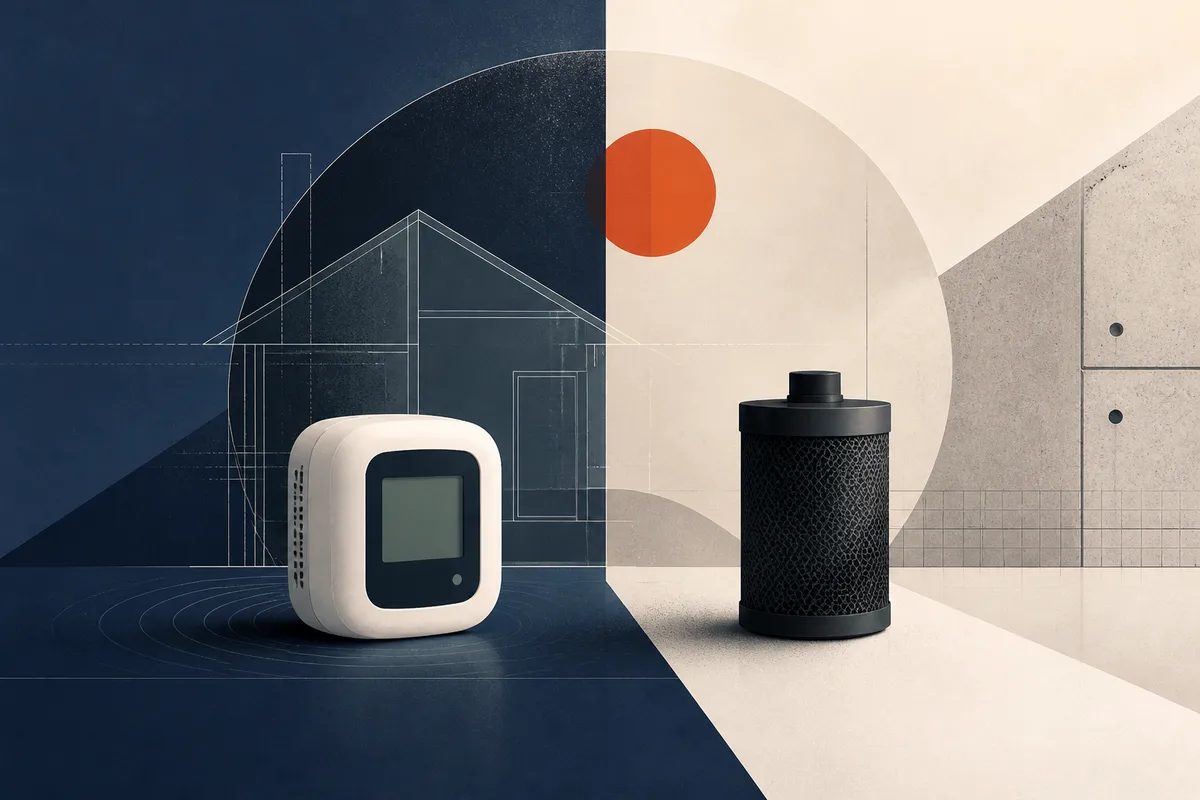
Choosing Between Continuous Radon Monitors and Charcoal Canisters
A standard real estate transaction moves too quickly for the inherent uncertainty of passive testing. While charcoal canisters are a low-cost entry point for residential screening, they may face scrutiny during a high-stakes property closing. Passive devices work by having radon in the air adsorb onto charcoal granules, but they are unable to distinguish between a temporary spike and a baseline level that requires mitigation.
This breakdown compares the technical merits of a continuous radon monitor vs charcoal canister for property managers and buyers who need more than an average. Relying on a single data point is a risk when a mitigation system installation—or the sale of a multi-family asset—hangs in the balance. Understanding the variance between active and passive technology is the first step in managing environmental risk during a transition.
Why Passive Testing Often Fails Property Transactions
Passive charcoal kits are vulnerable to environmental variables and human interference. Some charcoal technologies are prone to interference by high humidity, so they may not be appropriate for use in all buildings according to sosradon.org.
- Charcoal canisters may be affected by humidity or "back-diffusion," where the device may lose absorbed radon if concentrations drop toward the end of the test period.
- Passive devices cannot prove that "closed-house conditions" were maintained, leaving the results open to dispute if a window was opened.
- The lack of a time-stamped log means there is no way to identify weather-related spikes that might skew a short-term average.
- Shipping delays to out-of-state laboratories can result in radioactive decay, potentially compromising the short term radon test accuracy required for closing.
The Professional Testing Framework
For a testing protocol to hold up under professional scrutiny, it must move beyond simple absorption and into active data logging. According to the Oregon Health Authority, professional testing with continuous radon monitoring has the highest accuracy and follows the variations in radon levels.
1Verify Data Integrity via Hourly Tracking
Electronic monitors record concentrations every hour, allowing a technician to see the "rise and fall" of gas levels. This granularity helps differentiate between a temporary spike and a consistent structural issue. Continuous radon monitors are generally more accurate because they take hourly readings over several days, giving a full picture of the environment according to radon-guide.com.
2Monitor for Environmental Fluctuations
Professional monitors track the variations in radon levels continuously. If a homeowner moves a device or opens a window, the monitor logs the subsequent change in radon concentration. This creates an audit trail that protects the buyer's interests and provides data on location as noted by the Oregon Health Authority.
3Account for Atmospheric Changes
Radon levels often fluctuate in response to the environment. While charcoal canisters offer high sensitivity in terms of net counts per minute according to rtca.com, they cannot show hourly changes. By using a digital monitor, a professional can see if an elevated reading was a localized event or a systemic ventilation failure.
4Eliminate Laboratory Lag
Speed is a primary benefit of active testing. Because a continuous radon monitor provides results without a lab according to airthings.com, the report is typically available immediately. This eliminates the risk of samples being lost in the mail or degrading during transit to a lab.
The Superiority of Active Data Collection
The fundamental difference between active and passive testing is the ability to see the variation in levels. A charcoal canister provides a single number; if that number is 4.1 pCi/L, the property fails the EPA threshold, but the data does not show if that was due to a short-term spike or a constant level.
Professional monitors use active sensors to track levels in real-time. This allows for the detection of patterns, such as a sudden drop in radon levels, which may indicate that a window was opened. For commercial stakeholders, this level of detail is a reliable way to ensure a radon retesting protocol is capturing the building's true profile.
The measurement of how much radon levels shift hour-to-hour, used to identify weather influences versus structural soil gas intrusion.
How Minneapolis Radon Services Helps
Effective radon measurement for a real estate transaction requires a 48-hour window under controlled conditions. A professional approach involves placing electronic monitors in the lowest livable area of the home, ensuring the devices are away from drafts, direct sunlight, or high humidity. For those in the local area, a professional could test your home with an electret or continuous monitor to ensure the data survives the scrutiny of a home inspection. A sound scope of work includes a detailed report showing hourly graphs and clear mitigation recommendations if the average exceeds 4.0 pCi/L.
Frequently asked questions
Can weather affect the results of a charcoal canister more than a monitor?
Weather affects the radon levels in the home regardless of the device, but a charcoal canister cannot show the correlation. Because canisters only provide one average, a large storm during the test can skew the entire result. An electronic monitor allows an expert to see the impact of these variations.
Is a continuous monitor required for real estate?
While local laws may vary, the high standard of care in the real estate market makes electronic monitoring the professional norm. Most relocation companies and savvy buyers prefer electronic monitoring due to the ability to provide hourly data and verify that closed-house conditions were likely maintained.
How do electronic monitors detect if someone opened a window?
Professional monitors track hourly radon levels. If a window is opened, the device will log a sudden, sharp change in the concentration. This "dip" in the data graph is a clear indicator of a protocol violation, whereas a charcoal canister would simply report a lower, inaccurate average concentration.
Are charcoal canisters ever the better choice?
Charcoal canisters are often appropriate for initial, long-term screening where the homeowner is simply curious and there is no timeline or legal transaction involved. They are a cost-effective way to decide if further, more precise testing is needed. However, for any situation involving a contract, the accuracy of an active monitor is preferred.
What should I do if my charcoal test is high but I suspect it's wrong?
If a passive test returns a high result, the standard professional response is to perform a follow-up test using a continuous radon monitor. This confirmatory test provides the hourly data necessary to see if the first test was a fluke or if the property requires a permanent mitigation system installation. You can reach a specialist to discuss testing protocols at (952) 206-5195.
What happens when you get in touch: you describe the situation, we ask the few questions that actually change the answer, and you get a clear scope and next step — no obligation.